Madonna Quilt, 2026
Constructed from the artist’s used underwear, stitched together into a quilt
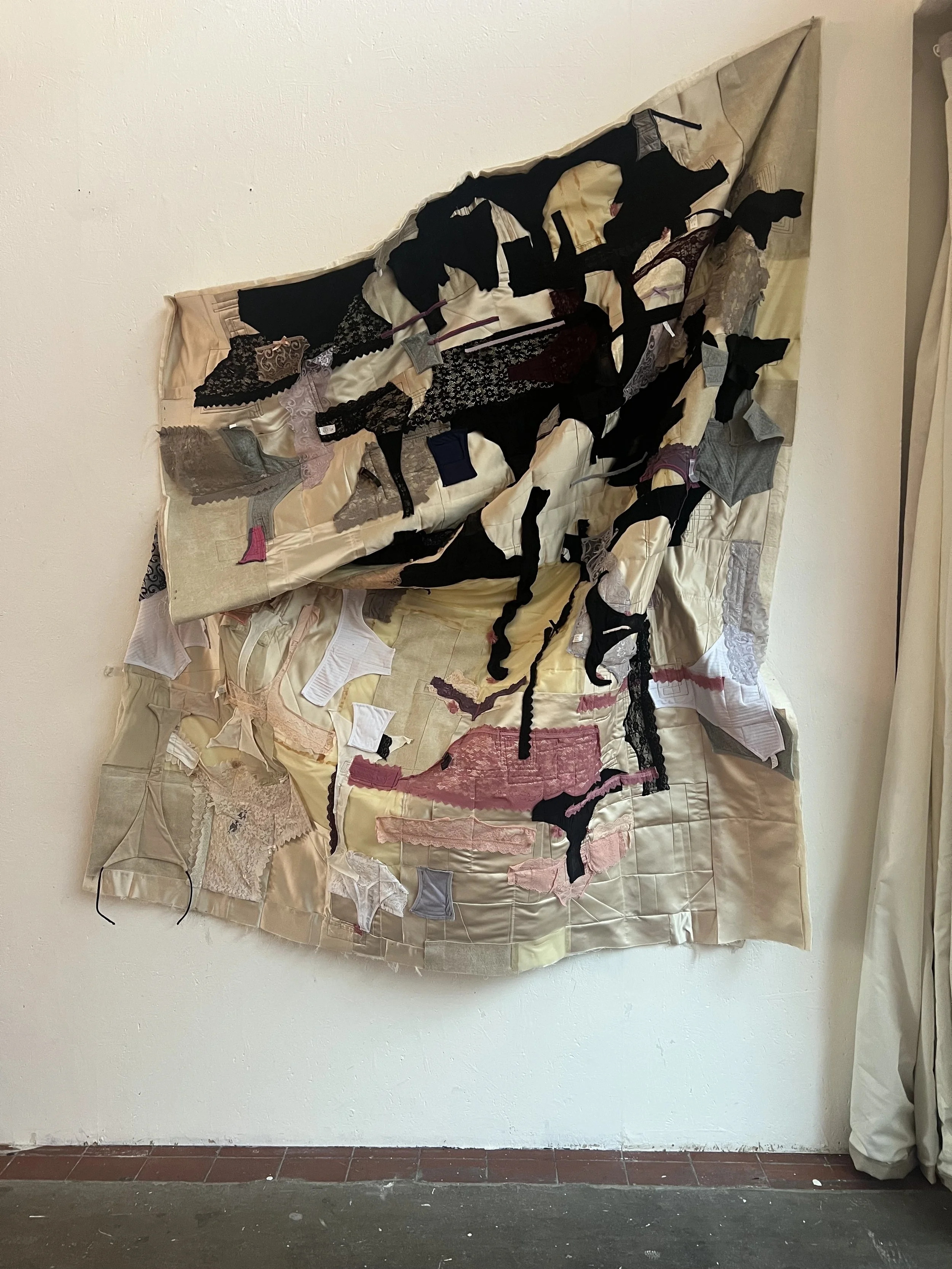
Satin, latex, velvet, leather, polyester, silk
This piece is constructed from the artist’s used underwear, stitched together into a quilt. A quilt is form traditionally associated with care, inheritance, and domestic labour. Each fragment of this quilt’s surface has been held close to the body. Each has absorbed time, activity, and waste. Underwear is typically private and often discarded. But in this piece it is reassembled into a unified surface and becomes an object that sits between utility and artifact.
The work is in reference to the figure the Virgin Mary. Not as a literal mother, but as a symbolic structure. A structure onto which ideas of origin, purity, and devotion are culturally projected. In this sense, Youme is not working with motherhood as lived experience, but with the idea of the womb: the place from which first life and first love are believed to have emerged.
The womb, and the maternal body are culturally positioned as sites of purity and safety. At the same time, they are deeply entangled with sexuality, and labour that are often obscured and regulated.
This tension between body and purity is central to the work.
Julia Kristeva writes in her book Powers of Horror, the abject is that which “disturbs identity, system, order.” It is not simply what is rejected, but what must be expelled in order for the self to be formed. These are bodily materials. Fluids, waste and traces of the body, sit within this category. They are both of the body, and no longer of it.
The materials in Madonna Quilt operate within this space.
Worn underwear exists at the threshold between intimacy and waste. It is held close, then removed and destroyed. In this sense, it is both deeply personal and deeply disavowed.
Kristeva’s work is particularly relevant in her framing of the maternal body and womb as the first site of this tension. She explains, the child as beginning in a state of proximity and dependency. But having to eventually separate from the mother and womb in order to become a distinct self. This separation is fueled by culturally sanctioned emotional hygiene.
In this way, the first site of worship is also the first site we are taught to reject.
Madonna Quilt underpins both psychoanalytic and evolutionary frameworks.
In evolutionary terms, Richard Dawkins in his book The Selfish Gene describes organisms as operating through what he calls “selfish” genetic imperatives. Where care and altruism are tied to survival and replication. The maternal body becomes a site of biological function, rather than purely moral or symbolic virtue. In this way, Dawkins explains the innate desire to worship the mother, by our innate desire to guarantee gene continuation.
At the same time, cultural narratives and the omnipresent symbol of the Madonna elevate the womb and the maternal body into something sacred, clean, and removed from its material and bodily conditions. The Madonna is hairless, free from adultery, and even perhaps without menstruation.
Madonna Quilt radically resists that separation.
Through the process of quilting, the work draws on traditions of craft and domestic labour. Practices historically feminized. A demographic often excluded from institutional hierarchies of art and worship. The piece becomes a way of evidencing fragments of lived, bodily experience. With the presence of biomaterial in the work.
But the Madonna Quilt holds an uncomfortable contradiction.
The quilt resembles an object of care, yet its material disrupts expectations of purity and acceptable devotion. What devotion is offered is not distance, but proximity. Not an abstract ideal, but a real body.
There is also an economic dimension to the work.
Worn garments, particularly underwear, circulate within niche economies where proximity to the body becomes a form of high erotic value. This complicates distinctions between intimacy and domestic and sexual labour.
Psychologist Nancy Friday documents in her book Men in Love, private fantasy often reveals a deep Freudian entanglement between desire, taboo, and the shame structures that attempt to regulate them.
Madonna Quilt sits within these overlapping systems:
· devotion and rejection
· intimacy and waste
· labour and value
It does not attempt to resolve them.
But instead perhaps to celebrate them. Or perhaps, to wrap us safely inside of them.