Summary of Research Project
July 09 2026
My research this year investigated proxy and proximity. What happens to intimacy, meaning, and the self when they are made to pass through a body or surface? A garment worn intimately against the skin and then transformed into an item of inheritance. A performer who stands in for the artist. In both cases something is transferred, and something is at stake in the transfer. The question is not whether the thing survives intact. The question is whether it was ever intact to begin with. I made two works in response: Madonna Quiltand Like ME (You?) Better Now.
Madonna Quilt is constructed from my own used underwear, stitched into a quilt. Satin, latex, velvet, leather, polyester and silk. The quilt is one of the most devotional objects in Western domestic culture. Traditionally the quilt is made from scraps. Specifically for memory quilts, those scraps were held close to the body. Often clothing of the deceased. Underwear is the garment closest to what the body is most required to manage: its fluids, its smells, its sexuality. These are the same things the figure of the Madonna makes invisible. To stitch that material into a quilt is a targeted transgression. The most private matter placed inside the purest form of domestic devotion. The work argues that devotion, in both the quilt and the maternal ideal, depends on hiding cost. On hiding a reality. Instead of hiding something, Madonna Quilt offers proximity to it. It holds this tension between reality, waste and permission. It stitches them together. Into one object of familial devotion.
Like ME (You?) Better Now is a durational performance in which a cast of performers act as proxies for me, the artist. Each presents the work as if they are the artist. They learn the work and its references. Content is delivered through different bodies, cultures and contexts, without explanation. The work exists only in the encounter between art-goer and performer. One performer, one viewer, and a conversation that is never announced as a performance. Nothing is fixed in an object, but in a relationship. Meaning is produced through proximity, assumption, and response. A body is read immediately. Before language, before correction, before permission. Like ME (You?) Better Now lives in that interval. As the actors rotate, the meaning rotates with them. Critical content has not changed at all. What is being observed is the instability of the artwork, through the change in the body that presents it. Here too the question is not whether the work is different through each body. But whether the meaning of the artwork was ever stable.
The two works share no material and no form. But the same space. They are the same enquiry approached from different directions. Madonna Quilt is a bodily trace with the body removed. A silent proxy. The trace of a body that cannot speak for itself. Like ME (You?) Better Now is the opposite. It is living proxies who speak, who stand in for the artist and carry the artwork with their own bodies. One keeps the body and loses the person. The other keeps the person and scatters the body across many. In both, the original is absent. The quilt is not me. It is what was close to me. The performer is not me. She is what speaks on my behalf. Neither work contains a true line to the original. Each is made of proxies and asks the viewer to accept proximity as honesty. This is the finding the research arrives at. Intimacy in these works is not closeness to an authentic thing, but closeness to its substitute. Proximity can and does exist without the requirement of an original.
Two shifts changed the work this year.
Like ME (You?) Better Now was originally conceptualized to use a single male doppelgänger. I cast an actor. He was my height, my hair color, my accent, the same gap in his teeth, and I commissioned prosthetic tattoos to match my own. The work was singularly about gender. In developing it I came to understand that a single male proxy made the work autobiographical. A statement about me, rather than a condition anyone else is subject to. I realized he could not carry Madonna Quilt, or any work that depends on feminized biology, without a degree of appropriation that I was not willing to make. Replacing him with a cast of proxies moved the work out of autobiography and into social commentary. It also brought the viewer inside its meaning, rather than leaving them to observe mine.
The elective Capital Shadow shifted Madonna Quilt. Asked to present a ‘shadow’ I proposed the loss of intimacy with our own bodies. It added a dimension to the quilt. It was not made of waste that happens to be intimate, but intimacy that culture has taught us to classify as waste. The material did not change. What it was evidence of did.
The enquiry does not end with these works. Both proxies so far have been material or human: a garment that held the body, a cast that stood in for the artist. The next is synthetic. ME. (you) Made Me is an autonomous erotic intelligence I am developing. She is a proxy with no literal body at all. But a digital one appropriated from my real one. She extends the same question into a realm without physicality. She is asked to carry physical intimacy, regardless of having anything physical at all.
I am continuing this work beyond the RCA through my art practice and through Intimacy Aura, which takes the enquiry into commercial and public contexts, where intimacy and proximity are addressed by products rather than art. The questions I am carrying forward are the ones these two works opened and did not close. What is owed to a proxy. What is transferred when a body stands in for another. And what proximity without an original beneath it carries at all.
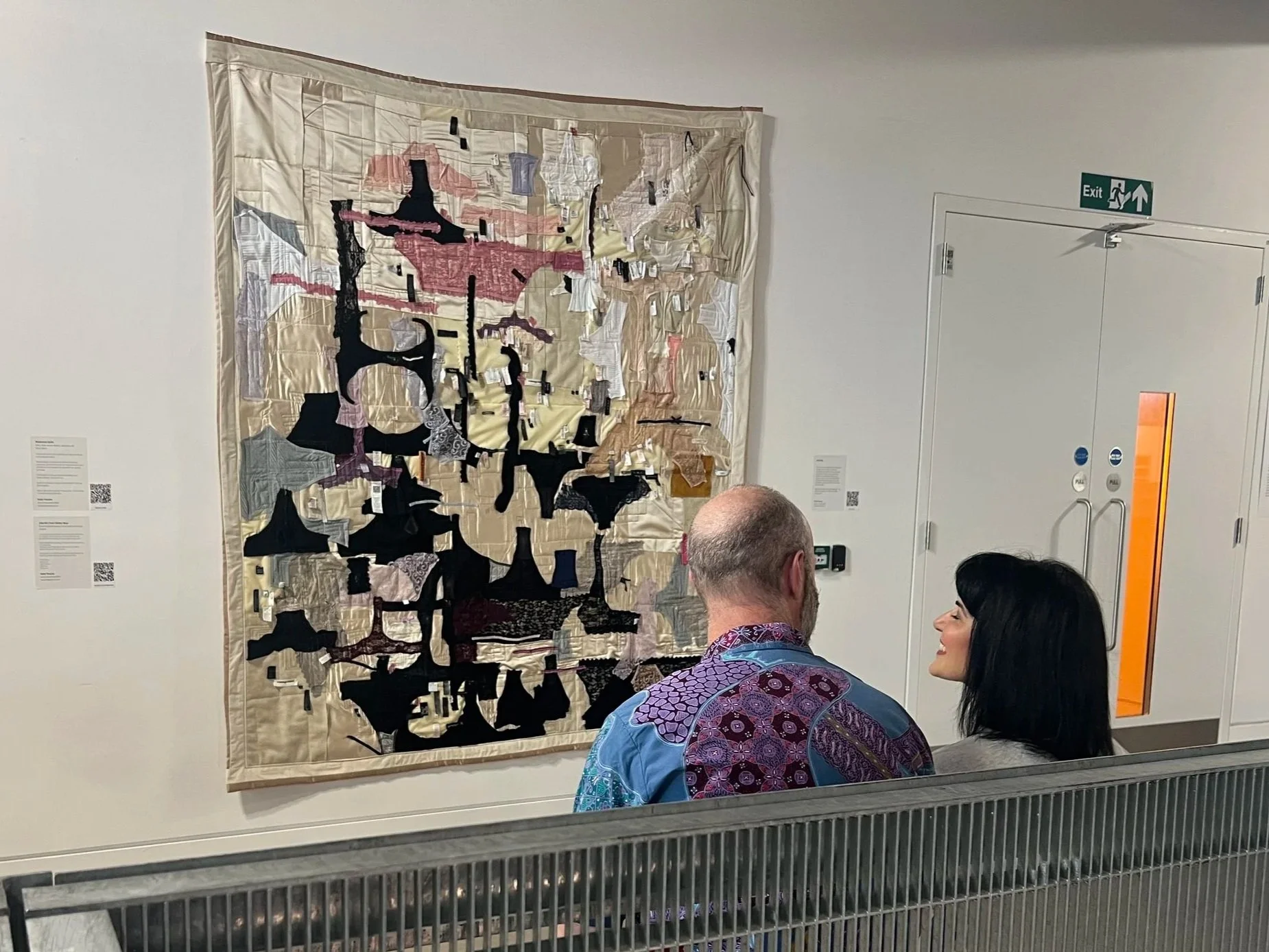
‘Today, I Am Youme Representing Madonna Quilt’
2026, 8.09 duration
A video. Archiving Like Me (You?) Better Now
Academic Article
- Women’s Studies International Forum Submission

The Body It Cannot Afford to Show: Madonna Quilt and The System of Devotion
Kate Youme, 2026
5,166 words
23 minute read
“This is what the quilt has always known. That what is left over is worth keeping. That the trace of a body is not waste. That devotion does not require the body to disappear in order to be real.”
Bibliography
Bourgeois, L. (2002) Ode à l'Oubli. Fabric book. New York: Museum of Modern Art. (new — worn clothing and household linen as material)
Calle, S. (2007) Take Care of Yourself. Arles: Actes Sud. (new — delegated authorship)
Chicago, J. (1979) The Dinner Party. Mixed media installation. New York: Brooklyn Museum. (new)
Dawkins, R. (1976) The Selfish Gene. Oxford: Oxford University Press.
Emin, T. (1998) My Bed. Mixed media installation. London: Tate.
Federici, S. (1975) Wages Against Housework. Bristol: Falling Wall Press. (new — hidden labour)
Federici, S. (2004) Caliban and the Witch: Women, the Body and Primitive Accumulation. New York: Autonomedia. (new)
Freud, S. (1912) 'On the Universal Tendency to Debasement in the Sphere of Love,' in J. Strachey (trans. and ed.) The Standard Edition of the Complete Psychological Works of Sigmund Freud, Vol. XI. London: Hogarth Press.
Friday, N. (1977) My Mother/My Self: The Daughter's Search for Identity. New York: Delacorte Press.
Friday, N. (1980) Men in Love: Men's Sexual Fantasies: The Triumph of Love over Rage. New York: Delacorte Press. (new — from Capital Shadow)
Hamilton, W.D. (1964) 'The Genetical Evolution of Social Behaviour I and II,' Journal of Theoretical Biology, 7(1), pp. 1–52.
Haraway, D. (1991) 'A Cyborg Manifesto: Science, Technology, and Socialist-Feminism in the Late Twentieth Century,' in Simians, Cyborgs and Women: The Reinvention of Nature. London: Free Association Books, pp. 149–181. (new — for ME.)
Hershman Leeson, L. (1973–1978) Roberta Breitmore. Performance. (new — the performed alternate self)
Jones, C. and Dawson, J. (2000) Stitching a Revolution: The Making of an Activist. San Francisco: HarperCollins.
Kristeva, J. (1982) Powers of Horror: An Essay on Abjection (trans. L.S. Roudiez). New York: Columbia University Press.
The NAMES Project Foundation (1987) The AIDS Memorial Quilt. Ongoing textile installation. Washington, D.C.: The NAMES Project Foundation.
Parker, R. (1984) The Subversive Stitch: Embroidery and the Making of the Feminine. London: The Women's Press.
Phelan, P. (1993) Unmarked: The Politics of Performance. London: Routledge. (new — performance as that which cannot be preserved)
Preciado, P.B. (2013) Testo Junkie: Sex, Drugs, and Biopolitics in the Pharmacopornographic Era (trans. B. Benderson). New York: Feminist Press. (new — for Intimacy Aura and ME.)
Russell, L. (2020) Glitch Feminism: A Manifesto. London: Verso. (new)
Sehgal, T. (2002) This is Propaganda. Constructed situation. (new — the work existing only in encounter)
Trivers, R.L. (1972) 'Parental Investment and Sexual Selection,' in B. Campbell (ed.) Sexual Selection and the Descent of Man. Chicago: Aldine, pp. 136–179.
Ukeles, M.L. (1969) Manifesto for Maintenance Art 1969! Proposal for an Exhibition: 'CARE'. (new — maintenance labour as art)